Gaudí's Lanterns in Plaça Reial: The Story of the Architect's First Public Commission
by Admin · Nook · Plaça Reial, Barcelona
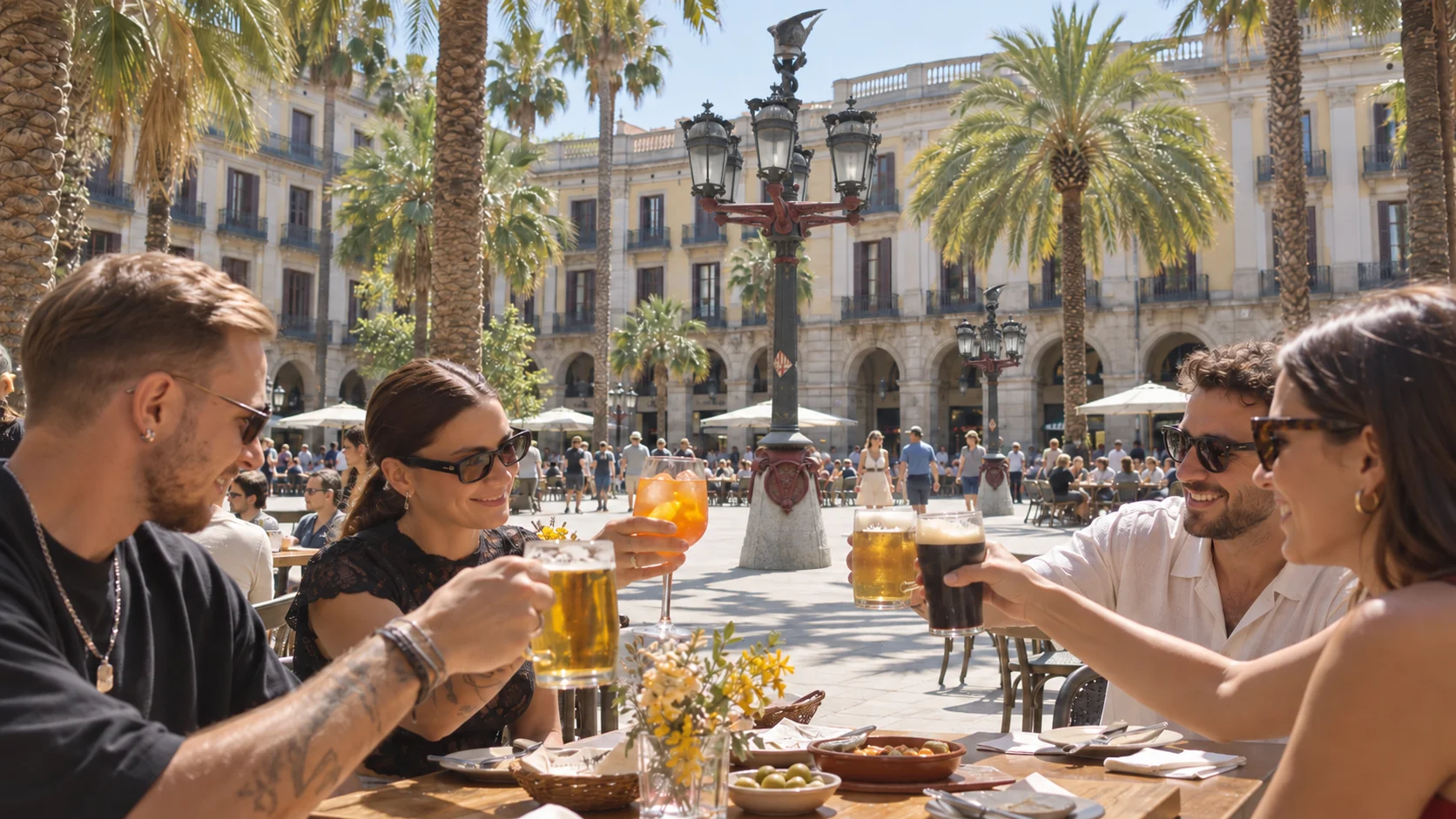
Every day, thousands of people pass through Plaça Reial. Many take a photo with the palm trees in the background, sit on a terrace, or cross on their way to La Rambla. Very few stop at the two iron lanterns that flank the central fountain. And yet, they are looking at a work by Antoni Gaudí without an entrance fee, without a queue, and without visiting hours: the first one commissioned by the Barcelona City Council. The story of how they got there begins long before, and explains why this square has a shape unlike any other in the historic center.
Before the square, there was a convent
The site that today occupies Plaça Reial belonged for more than a century to the Capuchins. The convent of Santa Madrona was built next to La Rambla starting in 1718, on land known as the Hort del Vidre, and its church was inaugurated in 1723.
What changed the fate of the place was the ecclesiastical disappropriation of the 1830s. Like many religious complexes in Barcelona, the convent disappeared and left a huge plot of land in the heart of the old town, an exceptional urban opportunity in a city still enclosed by walls and with an suffocating density.
1848: A competition to dignify the center
In May 1848, the City Council announced a competition open to Spanish architects to urbanize the vacant space. The project by Francesc Daniel Molina won, inspired by French neoclassical squares: a closed area, trapezoidal in shape, surrounded by a uniform perimeter of porticoed buildings.
The works began shortly after and continued throughout the following decade. The square has a notable uniqueness in a city full of unfinished projects; it was executed entirely according to the initial design.
The name and intention were equally explicit. The square was meant to exalt the monarchy, and a royal monument was planned for the center. That monument never occupied its place, and instead, the Fountain of the Three Graces was left, which is what today organizes the space.
1878: A newly graduated architect and a fortunate mediation
Three decades later, the square needed monumental lighting. And this is where the story becomes almost novelistic.
The commission was first offered to Jaume Serra i Gibert, a painter, engraver, and goldsmith, who passed away shortly after. It was then that the architect Joan Martorell, master and mentor of a young Gaudí, mediated for the job to go to his disciple. Mayor Albert Faura referred to him in a letter in February 1878 as a "young and resourceful architect."
The commission was officially granted on March 15, 1878. The detail that rounds out the anecdote: Gaudí was not yet an architect. His title was issued on May 15 of that same year, two months after receiving the job.
What you are exactly looking at
The lanterns were installed in 1879. It is advisable to approach knowing what to look for.
-
They are two six-armed lanterns, placed on either side of the central fountain.
-
They are topped with a winged helmet, the iconographic attribute of Mercury, the god of commerce, a declaration of intentions about what this square aspired to be.
-
Gaudí proposed four lanterns forming a square around the fountain. The idea was dismissed, so the square retains a reduced version of his original project.
-
They were restored in 1965 and again in 1982, but along the way, the original polychromy was lost. What we see today does not have the color it once had.
-
They are not the only ones: in Pla de Palau, there are two others, with three arms, belonging to the same design.
It is probably Gaudí's most accessible work in Barcelona. It does not require reservations months in advance or an entrance fee, and it is surrounded by terraces. The paradox is evident: in a city that has made Gaudí its main attraction, his first public commission goes unnoticed in one of the most frequented points in the center.
The palm trees and a square that has experienced everything
The lanterns are not the only element that has changed over time. The palm trees that today give the square that almost tropical air were not part of Molina's original project: they were planted starting in 1883, more than three decades after the buildings were erected, at a time when the Barcelona bourgeoisie sought to give their public spaces an exotic and cosmopolitan touch.
The square then experienced its peak of social splendor: some of the most influential newspapers in the city, such as La Vanguardia or El Diluvio, had their editorial offices there, and the main political circles operated. That relatively peaceful world was shaken in 1892 by an anarchist attack that caused one death and several injuries, an episode that marked the beginning of a more tumultuous period that, over time, gave way to decades of decline before the recovery that the space enjoys today.
Telling this is important because it dismantles a mistaken idea: Plaça Reial is not an immovable backdrop since 1850. It is a space that has been a bourgeois square, an editorial office for newspapers, the scene of an attack, and, decades later, one of the liveliest restoration points in the Gothic Quarter. Gaudí's lanterns have witnessed all these stages without moving an inch.
A young Gaudí before becoming "the Gaudí"
It is also important to place the architect himself in his moment. In 1878, when he received the commission for the lanterns, Gaudí was still nobody outside his academic circle, he had just graduated, and his first commissions of that same year the lanterns, the project for the Girossi Kiosks, a showcase for a glove shop in the center were minor works, typical of someone just starting out. The Sagrada Família would not arrive until 1883, Casa Vicens until those same early years of his career, and international recognition, much later.
The lanterns of Plaça Reial are therefore not a secondary work of an already established genius, but the first professional step of an architect who still had to prove everything. Seeing them today is seeing the beginning of a trajectory, not its epilogue.
Anyone who wants to pull the thread can do so without leaving the historic center; Casa Vicens, in the Gràcia neighborhood, is Gaudí's first major building and tends to go much more unnoticed than the Sagrada Família or Park Güell among those visiting the city. Between lanterns from 1879 and a building from the following decade, one can reconstruct, step by step, how one of the most influential architectural careers in Europe begins.
The porticoes, the grill, and a square designed to be lived in
There is something that Molina's design understood well and that still works; a porticoed square is not crossed, it is inhabited. The arcade offers shade in summer, shelter when it rains, and a transition between the street and the interior that invites one to stay.
The Nook Restaurant occupies just that place, at number 8, under the arches. Grilled cuisine and tapas to share, in a space that takes advantage of exactly what the square was designed for almost two centuries ago: to gather people without hurry in the heart of Ciutat Vella.
You can dine looking at the lanterns. It is worth knowing what they are.
Reserve your table at Nook, Plaça Reial 8, and enjoy the grill with Gaudí's first public work just a few meters away.
Reservations on the website or at 932 783 983.
Sources
- Cultural Heritage — Generalitat de Catalunya: Plaça Reial file
- Turisme de Barcelona — Plaça Reial
- El Nacional — 175 years of history of Plaça Reial (with data from the Heritage Catalog of the Barcelona City Council)
- Documentary file on the lanterns of Plaça Reial and the chronology of the commission to Gaudí
- Barcelona City Council — Barcelona Metròpolis: splendor, decline, and recovery of Plaça Reial